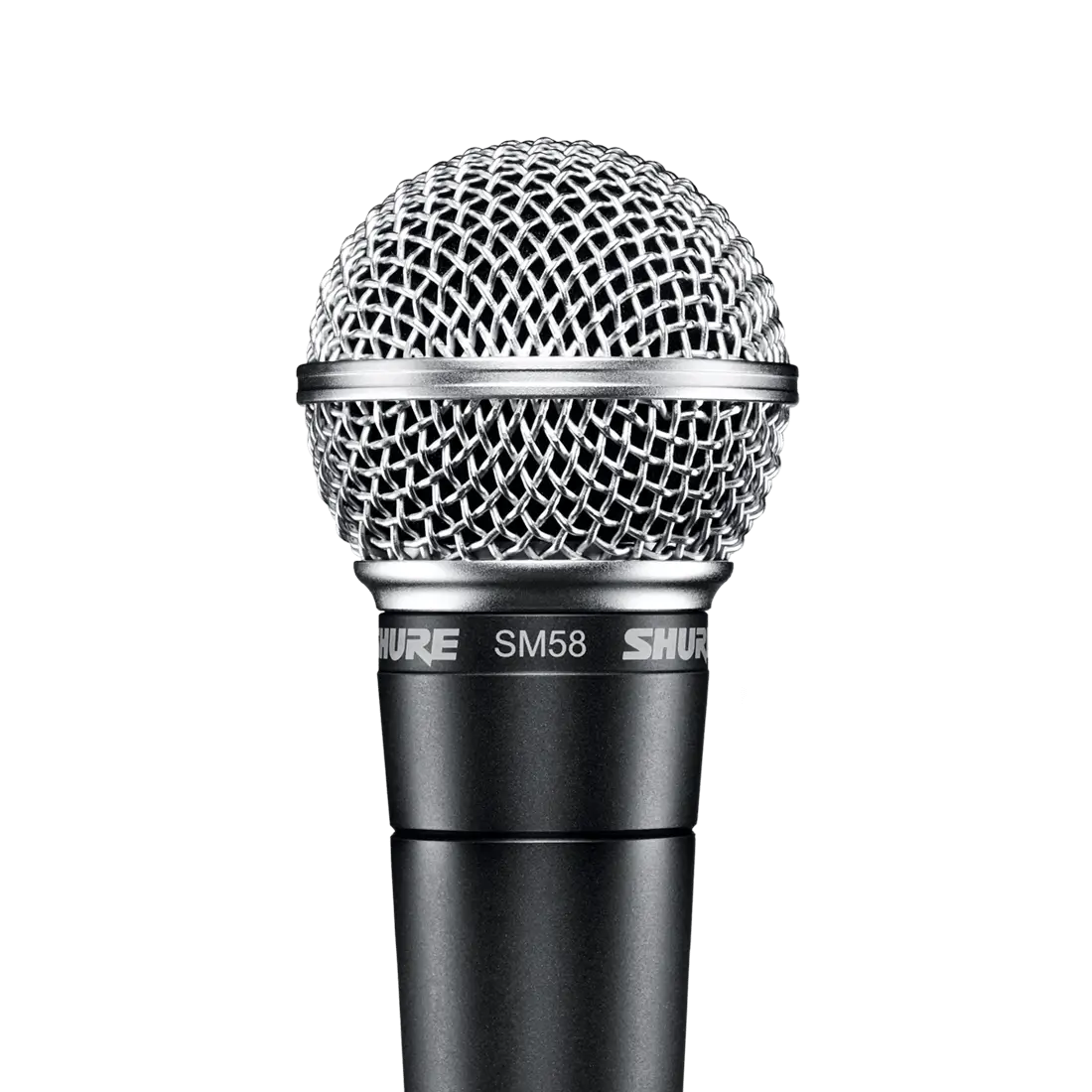
Choosing Between the SM58 and the Nexadyne 8 for Live Vocals

Somewhere in a rehearsal space, a basement show, or a battle of the bands you'd rather forget, you probably held an SM58 for the first time. Later came the debut album, the first sold out show, or perhaps being able to record and tour with the studio musicians once considered out of budget. As a musician, there are no shortage of these sentimental moments: the spaces we grew in, memories made with collaborators, and the gear that brought it all together. Whether we knew it or not, it all started with the SM58. We might have even dropped it… a couple of times... and yet, it delivered for us with a clarity we could trust. That's the entire point, and it's why the SM58 is still the mic most performers reach for first.
When it’s time to upgrade, the clear choice is the Nexadyne Family of microphones from Shure. With this article, you’ll be able to clearly understand the differences between the two vocal microphones of this series, the 8/C and 8/S, and to identify when your stage has outgrown the SM58. We will take a serious look at how your performance needs change when the rooms get bigger, the monitors get louder, and the mix gets more crowded. Shure built the Nexadyne 8/C and 8/S so that you could meet these moments, and command the stages which were once only a dream.
Over 60 years of the SM58
The SM58 was released in 1966 thanks to a technology developed by Ernie Seeler. The Unidyne III, which powers today’s 545, 565, SM57 as well as the SM58 microphones, fundamentally changed live performance microphone capabilities. For one, this technology marked the beginning of unidirectional microphones in which the speaker projects their voice into the end of the microphone. Before this, the vocalist would speak or sing into the side. The very shape that is automatically associated with microphones in our head can be traced back to Ernie’s work, and it also represented a technological response to the stages getting bigger.
Another reason that the SM58 is an industry standard is its uniform cardioid pickup pattern and its built-in spherical filter. This significantly reduces the chance of clipping, feedback, and background noise, making it much more forgiving to all musician levels when compared to a studio condenser microphone.
All this along with the infamous rugged construction. The next time you’re killing a few minutes with the technical director, ask them about their best drop test. Ernie wasn’t only developing a microphone for bigger stages, but also one that could pass tests of durability designed by the military. Fast forward today, and the SM58 is backed by the numbers: with regular use, it’ll last you reliably for over a century.
How to know if you’ve outgrown the industry standard
The versatility of the SM58 birthed a standard, but as your mix gets denser, your engineer may need to fight for space to make your vocal cut through without smearing the rest of the band. Soundchecks may begin to take longer in the pursuit of a truly clean vocal which can be controlled during the performance. This risk grows with additional vocalists or a stage plot with constant changes to instrumentation. None of this is a flaw in the SM58, but rather a mismatch between a mic designed for broad, forgiving reliability and a stage that now needs more precision.
If you have a keen ear, you may be picking up on this sonically rather than logistically. The bleed you hear in the monitor is more than it used to be, or you’re feeling the need to push your vocal chords or enunciate differently to help your voice cut through. Or maybe your fans or team have approached you directly to say: it’s time to look at what’s next.
Enter Nexadyne: same reliability, more precision At the center of the Nexadyne family is Shure's patented Revonic dual-engine transducer technology. These two precisely calibrated transducers work together inside the capsule to tactically shape frequency response and manage unwanted noise. This differs from the single transducer found in most dynamic microphones, and while the Nexadyne 8/C and 8/S both utilize these dual-engine transducers, each one is notably built for different rooms. Have a look at the differentiation:
SM58 | Nexadyne 8/C | Nexadyne 8/S | |
| Polar pattern | Cardioid | Cardioid | Supercardioid |
| Transducer design | Single transducer | Dual-engine design | Dual-engine design |
| Ideal stage size | Small to mid-size venues, untreated rooms | Mid to large venues, denser mixes | Large venues, high volume or high bleed stages |
| Soundcheck / EQ needs | Reliable, but may need more corrective EQ in loud rooms | Reduced corrective EQ, faster dial-in | Reduced corrective EQ, fsater dial-in, extra signal isolation |
| Vocal style fit | Broad, forgiving, works for most voices | Natural, open, detailed | Focused, controlled, cuts through dense mixes |
| Build | Legendary, built with military-quality durability testing | Touring-grade construction | Touring-grade construction |
| Where it shines | Bars, small stages, acoustic sets, first tours | Growing acts stepping into bigger rooms | Loud stages, festivals, high-volume monitor setups |
Note the cardioid pattern of the 8/C. This is a natural, open pickup similar in spirit to what you already know from the SM58, just cleaner and more detailed. The 8/S steps up to a supercardioid pattern and therefore brings an even more intense fine-tuning to the table. This pattern enables a tighter rejection of off-axis noise, which makes it the better fit for louder stages, the densest of monitor setups, or situations where isolating your vocal from stage volume matters most.
Knowing when and why to upgrade
As musicians, we know that there is always another piece of gear tempting us. What defines the professionals is the ability to distinguish when an upgrade will best serve them, and not doing so too late. If you’re considering the switch from the industry standard to Nexadyne, ask yourself a few quick questions:
- What size of rooms and stages am I currently playing, and how will that change in the next few years? How loud are these stages?
- How has my input list changed or grown since I started, and do I anticipate it to grow more? How has this, if at all, impacted how I hear the set, and the feedback I’m hearing from my team and fans?
- How often is the front of house using corrective EQ on my voice? Has their effort to make my shows sound the best they can gone beyond mixing and into a territory that gear can achieve for us?
Your road to shorter sound checks
Nexadyne Vocal mics build on Shure's tradition of reliability, bringing even greater precision, clarity, and transparency to your voice in a growing mix–all while cutting down unnecessary sound check time, and saving your voice for the moments that matter most. Learn more about the Nexadyne Vocal microphones here.